


Selling a home in Clydebank?
You’ll need an up-to-date Home Report available to potential buyers when you put your property on the market.
We provide Home Reports across West Dunbartonshire from our local Glasgow office, with clear reporting and practical guidance throughout the process.
Quick Answers about selling a home in Clydebank
Do I need a Home Report to sell in Clydebank?
Most homes sold in Scotland require a Home Report, with some exceptions (e.g., private sales not listed on the market). The seller or their agent must provide it.
How old can the Home Report be?
When a property is put on the market, the Home Report must be no more than 3 months old.
What’s included?
A Home Report has three parts:
Single Survey
Energy Report
Property Questionnaire
Get in touch for a quote now

Local Market Snapshot
Clydebank’s property prices are lower than the national average. The average price for property in the area stood at £144,270 in January 2025. Though different property types have had different sold prices in the last 12 months. Detached properties for instance sold for an average of £293,252; semi-detached for £194,377; terraced for £149,453; and flats for £97,335.
However, there are a number of ongoing new build developments in the area from the likes of Millar, Cala and Taylor Wimpey, with prices ranging from £190,000 to over £300,000.
Glasgow West End Office Details
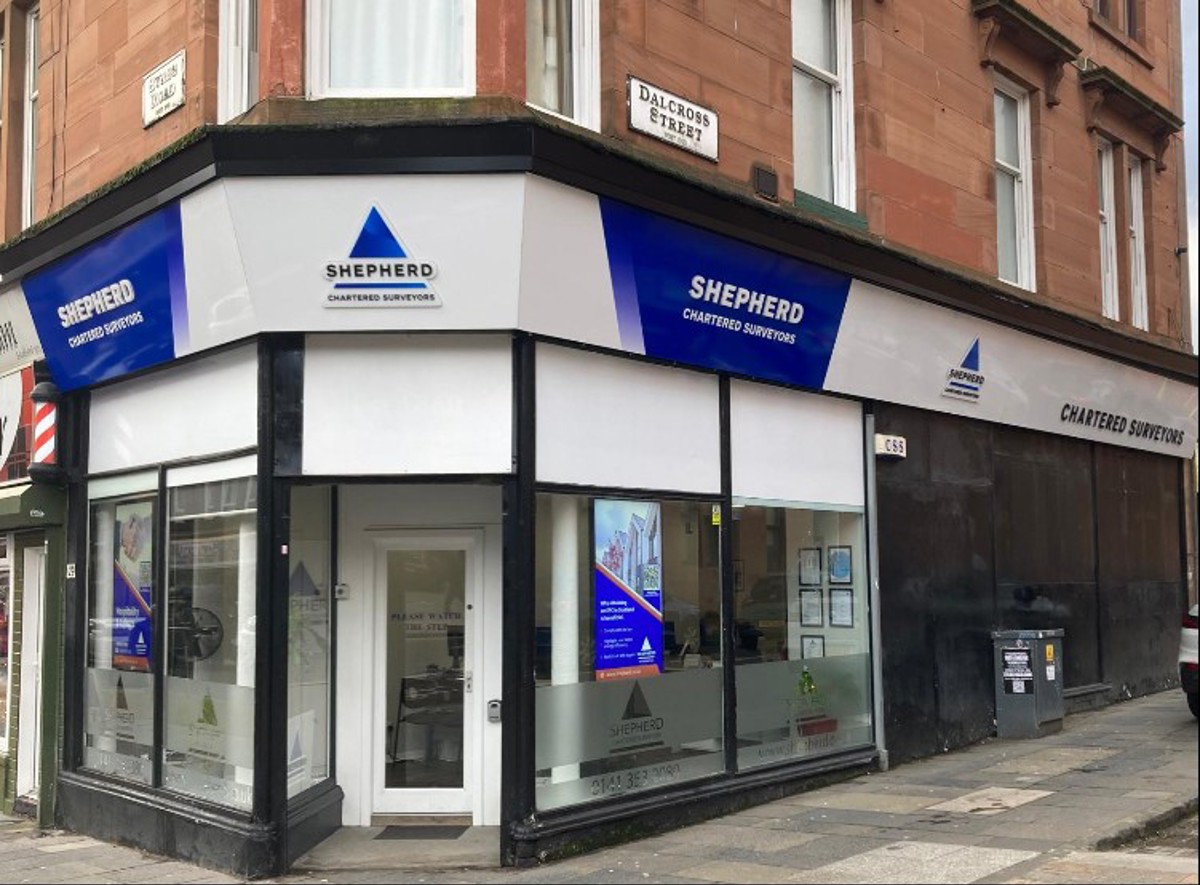
Shepherd Chartered Surveyors — Glasgow West End
31 Byres Road, Glasgow, G11 5RD
Opening Hours
Monday – Thursday: 9:00am to 5:30pm
Friday: 9:00am to 5:00pm
Why local knowledge matters
Clydebank is known as an industrial town in West Dunbartonshire. It is located in the historical boundary of the ancient Kingdom of Strathclyde and also encompasses part of the Antonine Wall of the former Roman Empire, now a World Heritage Site. Prior to the industrial revolution that saw the town transformed, it was mainly a rural area of some small villages, with the main economic activity agricultural in nature, but supported with other small mills and mines here and there. A distant memory of what it would go on to become into the 20th century.
Indeed, the modern-era genesis of Clydebank began in the 1870s with the decision by trustees to compulsory purchase the Clyde Bank Iron Shipyard in Govan. The J&G Thomson company, forced to relocate, found suitable land further afield in the Forth and Clyde canal, and, close to the road running westerly from Glasgow to Dumbarton. This land was particularly important because it allowed for the construction of larger and heavier ships than what was capable at the old Govan site. As development was completed and the business grew, more workers were attracted to the area, and the company began to build local tenement housing to cater for its ever-growing workforce to save transporting them back and forward on clippers up and down the River Clyde. Gradually, as time went on the area developed further, more manufacturers and employers moved in, and by the turn of the century, some 2000-3000 people lived and worked there. The area was officially made a new town and named for the original shipyard ‘Clydebank’.
So important was its shipyards that on 13 and 14 March 1941, Luftwaffe bombers attacked various targets in and around Clydebank. In what became known as the Clydebank Blitz, the town was seriously damaged as were the local shipyards, the Dalnottar Royal Navy oil depot, and the Singer’s Sewing Machine factory. Over the two days, 528 civilians were killed and over 617 people were seriously injured.
Nowadays the heyday of Clydebank’s shipbuilding has since passed, and while the original shipyard has since closed the yard and associated engineering works has been redeveloped, with tourist attractions such as the Titan Clydebank Crane and a new campus for Clydebank College, part of the merged institution West College Scotland. Recent years haven’t been the best for the area however a new £10 million “Clyde Mission” action plan has been announced to benefit the wider West Dunbartonshire area to create sustainable economic growth throughout the region. A further £25 million has been earmarked over five years from 2021 on a variety of projects to attract investment and industry to the river corridor.
In terms of amenities, Clydebank has a selection of local restaurants and cafes, and many pubs which also serve food. The town has a variety of shops, including the Clyde Shopping Centre which also has a cinema and includes a bridge over the Forth and Clyde Canal. Clydebank is a great base for travel to Loch Lomond and the Trossachs National Park which is less than 40 minutes by car.
In terms of transport links, a bus terminus sits at the southern end of the shopping centre and connects the town to Glasgow and the surrounding areas. The town is served by several railway stations, primarily Clydebank railway station which has regular services to Dalmuir, Glasgow city centre, and further afield. The Erskine Bridge at Old Kilpatrick connects the A82, which bypasses Clydebank to the north of the town, to the M8 motorway running between Greenock, Glasgow Airport, Paisley and further across Scotland. Clydebank has an advantageous position for its proximity to Glasgow Airport. While not the closest, it is still only about 15-minute drive away.
What do you get in a Home Report?
Single Survey
A professional inspection that provides a snapshot of the property’s condition at the time of inspection, with clear condition ratings and notes.
Energy Report (includes EPC)
An overview of energy performance and emissions, plus recommended improvements. If you’re producing a Home Report, the EPC is included within it.
Property Questionnaire
Completed by the seller, covering practical information a buyer needs (for example, council tax band, utilities, parking, alterations and factoring arrangements where relevant).
How it works
Request a quote
Via online form
Book the inspection
Arranged at a suitable time for you
Survey completed
By a qualified RICS surveyor
Home Report issued
Ready to share with your prospective buyers
Shepherd tip: What affects the cost?
FAQs
Frequently asked questions about Residential Services
Most homes marketed for sale in Scotland need a Home Report, but there are exceptions (for example, certain private sales not put on the market).
Yes — if you’re producing a Home Report, the EPC is included as part of it.
Not necessarily. Access can often be arranged via your selling agent, keysafe, or other agreed method.
The report may recommend specialist checks for particular issues. If that happens, we’ll explain what it means and what people usually do next.
“”