


Selling a home in Milngavie?
You’ll need an up-to-date Home Report available to potential buyers when you put your property on the market.
We provide Home Reports across East Dunbartonshire from our local Bearsden office, with clear reporting and practical guidance throughout the process.
Quick Answers about selling a home in Milngavie
Do I need a Home Report to sell in Milngavie?
Most homes sold in Scotland require a Home Report, with some exceptions (e.g., private sales not listed on the market). The seller or their agent must provide it.
How old can the Home Report be?
When a property is put on the market, the Home Report must be no more than 3 months old.
What’s included?
A Home Report has three parts:
Single Survey
Energy Report
Property Questionnaire
Get in touch for a quote now

Local Market Snapshot
As of January 2025, the average price for property in Milngavie stood at £321,962. Though different property types in Milngavie have had different average selling prices over the last 12 months: £518,708 for detached properties, £327,706 for semi-detached, £224,870 for terraced, and £189,380 for flats. This average hides quite a range though, and it is not uncommon for properties in the town to sell for well above this average, with some even reaching £750,000 or higher depending on the property, the finish, available land, and even particular street.
Bearsden Office Details
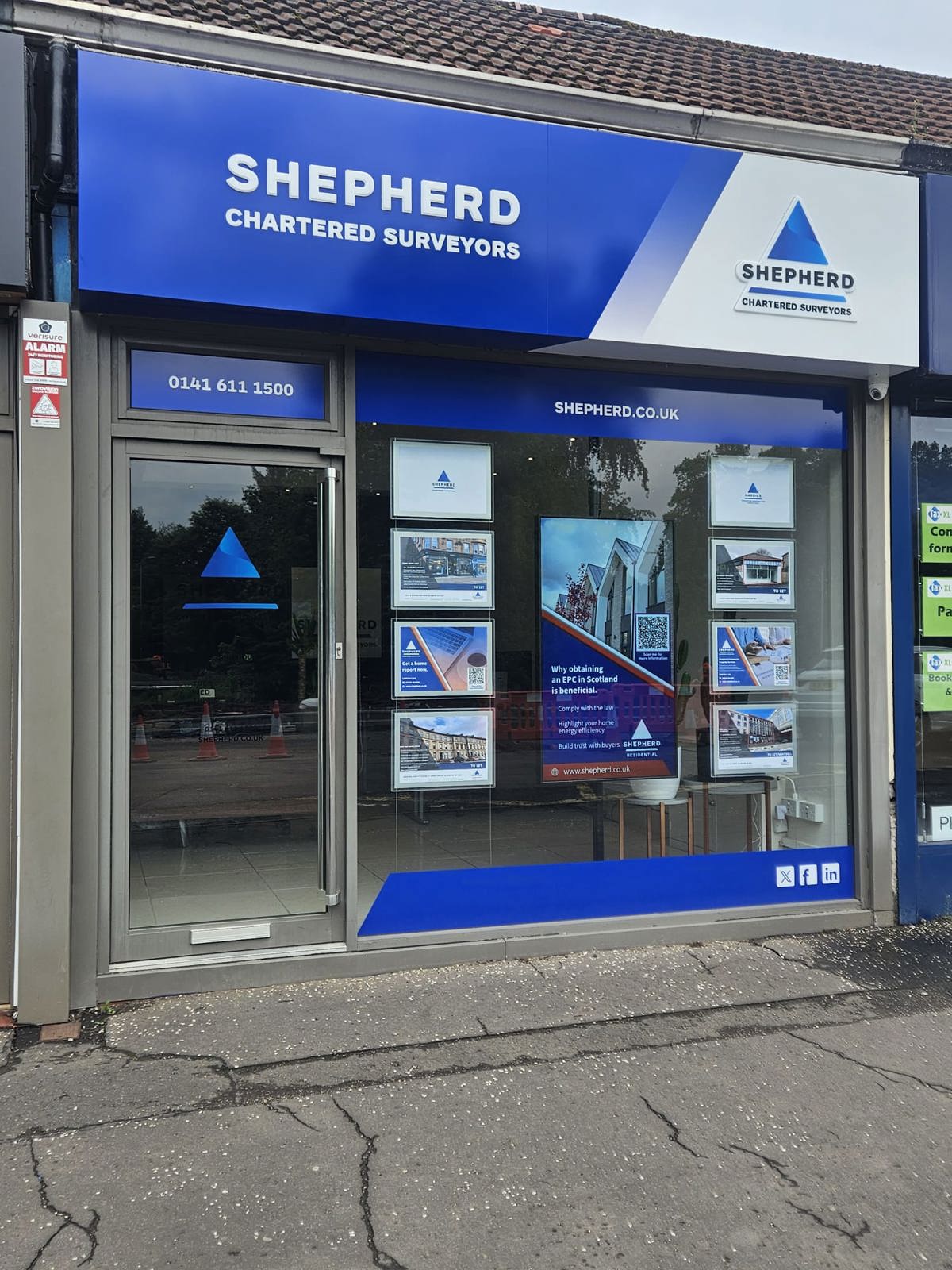
Shepherd Chartered Surveyors — Bearsden
4 Canniesburn Toll, Bearsden, G61 2QU
Opening Hours
Monday – Friday: 9am to 5pm
Why local knowledge matters
Milngavie is a thriving and affluent town in East Dunbartonshire of roughly 13,500 residents. It is on the Allander Water, at the northwestern edge of Greater Glasgow, about 8 miles from Glasgow city centre. It shares a border with the similarly affluent town of Bearsden to the south. In the 19th century, the town and area had several active industries including milling and textiles. However, it was in 1863 when the railway arrived that Milngavie as we know it today began to take shape. Many more people began to come to the town over time, including many wealthier citizens, who began to build stone villas and semi-detached homes to the east of the town centre and around Tannoch Loch. The town saw growth again with the building of many private housing developments of bungalows and semi-detached homes to the south of the town centre and to the west in the 1950s and 1960s.
Milngavie today then is a desirable commuter town, with much of its working population travelling to Glasgow for work or study. It is an ideal location for this, as travel times are relatively short and transport links well established. This along with the attractive housing stock throughout the area, and excellent schools, compound together to create a highly sought-after residential town.
As mentioned, transport links are excellent. The town has its own railway station – Milngavie station – with regular daily services to and from Glasgow Queen Street station in about 25 minutes. The A81 Glasgow/Milngavie/Maryhill Road is one of the main trunk roads for commuters travelling by road and is easily accessible. Bus services are also frequent for local travel and further into Glasgow again for example.
In terms of amenities and things to do, Milngavie has a plethora of things to enjoy. The pedestrianised town centre is known locally as ‘Milngavie Precinct’ and has a range of shops and restaurants as well as a local bookshop. Indeed, the town is not lacking in quality eateries of all kinds. The town is also the starting point of the West Highland Way and nearby Mugdock Country Park is an excellent park for woodland walks and wildlife spotting. Avid golfers are spoilt for choice with no fewer than five 18-hole courses in the immediate area. Residents can also take advantage of the various amenities in Bearsden too with the town being so close.
In terms of local schooling, primary education is provided by Clober Primary, Craigdhu Primary and Milngavie Primary schools. The local secondary school is Douglas Academy which includes a music school for gifted children who gain entry through audition and board in Glasgow’s West End. Douglas Academy has been ranked as Scotland’s best state school in the past, and most years it is among the highest in the country. There is a private nursery and primary school that forms part of the Glasgow Academy, whose senior school and other departments are located at Colebrooke Street in the West End of Glasgow.
What do you get in a Home Report?
Single Survey
A professional inspection that provides a snapshot of the property’s condition at the time of inspection, with clear condition ratings and notes.
Energy Report (includes EPC)
An overview of energy performance and emissions, plus recommended improvements. If you’re producing a Home Report, the EPC is included within it.
Property Questionnaire
Completed by the seller, covering practical information a buyer needs (for example, council tax band, utilities, parking, alterations and factoring arrangements where relevant).
How it works
Request a quote
Via online form
Book the inspection
Arranged at a suitable time for you
Survey completed
By a qualified RICS surveyor
Home Report issued
Ready to share with your prospective buyers
Shepherd tip: What affects the cost?
FAQs
Frequently asked questions about Residential Services
Most homes marketed for sale in Scotland need a Home Report, but there are exceptions (for example, certain private sales not put on the market).
Yes — if you’re producing a Home Report, the EPC is included as part of it.
Not necessarily. Access can often be arranged via your selling agent, keysafe, or other agreed method.
The report may recommend specialist checks for particular issues. If that happens, we’ll explain what it means and what people usually do next.
“”